Brun Fine Art
Skip to main content
  • Menu
  • ARTWORKS
  • EXHIBITIONS & FAIRS
  • NOTABLE SALES
  • PUBLICATIONS
  • Press
  • SERVICES
  • CONTACTS
  • EN
  • IT
Menu
  • EN
  • IT

ARTWORKS

Open a larger version of the following image in a popup: Trapani, Reliquary Holy Water Font, 17th/18th century

Trapani

Reliquary Holy Water Font, 17th/18th century
Gilt copper, corals
42 x 38 cm

Expertise by Roberto Valeriani
Trapani, 17th/18th century
Enquire
%3Cdiv%20class%3D%22artist%22%3ETrapani%3C/div%3E%3Cdiv%20class%3D%22title_and_year%22%3E%3Cspan%20class%3D%22title_and_year_title%22%3EReliquary%20Holy%20Water%20Font%3C/span%3E%2C%20%3Cspan%20class%3D%22title_and_year_year%22%3E17th/18th%20century%3C/span%3E%3C/div%3E%3Cdiv%20class%3D%22medium%22%3EGilt%20copper%2C%20corals%3C/div%3E%3Cdiv%20class%3D%22dimensions%22%3E42%20x%2038%20cm%3Cbr/%3E%0A%3Cbr/%3E%0AExpertise%20by%20Roberto%20Valeriani%3C/div%3E%3Cdiv%20class%3D%22signed_and_dated%22%3ETrapani%2C%2017th/18th%20century%3C/div%3E
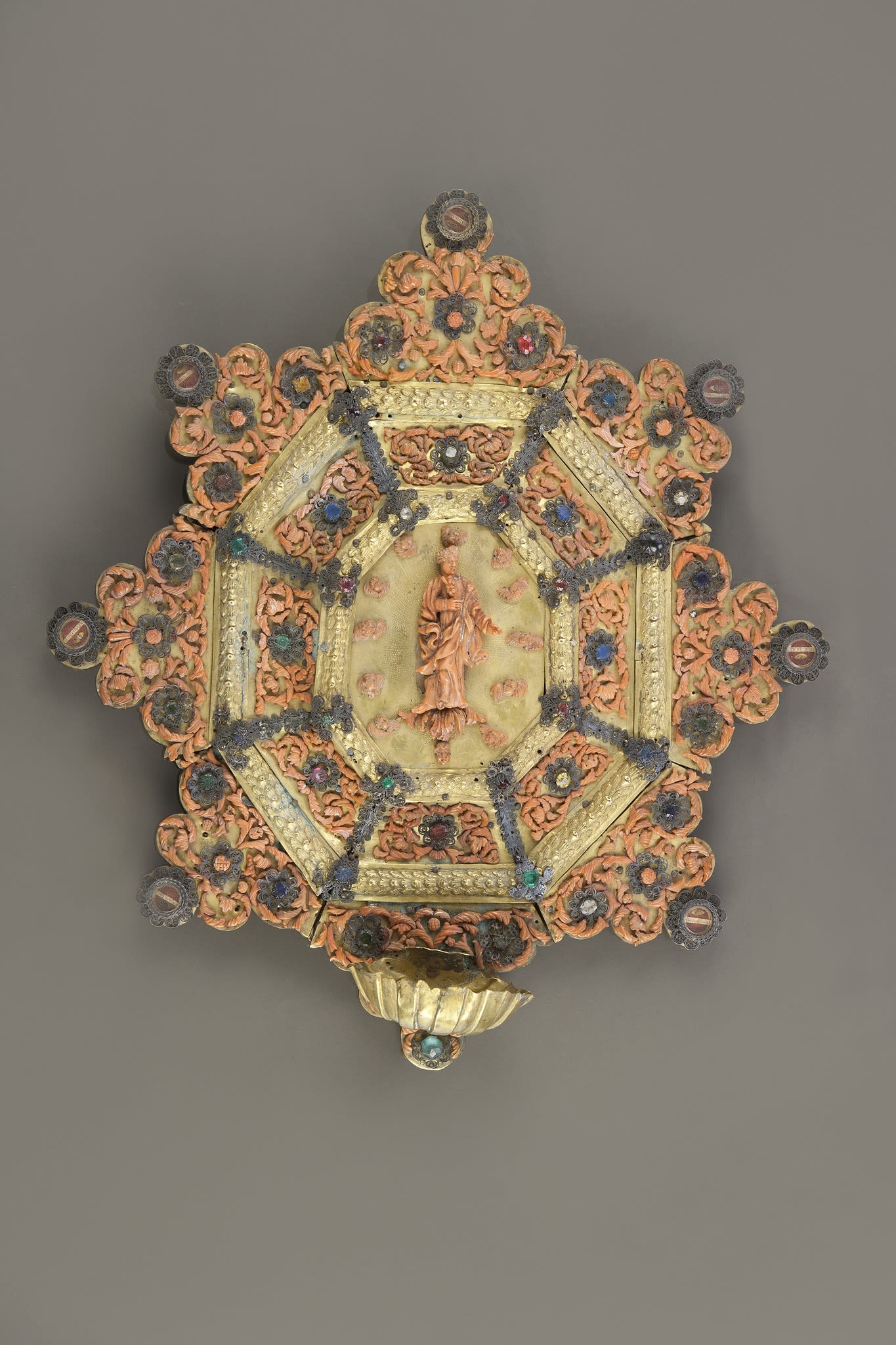
Radial motifs in silver punctuate the central octagon, whose focal point is the image of the Virgin surrounded by cherubs. A dense pattern of coral pieces carved to form leaf motifs covers the segments of the octagon and the outer edge, embellished with silver flowers; those around the edge contain relics. At the bottom is the small basin in the shape of a shell. This type of decoration, with the lavish use of applications in silver foil, that act almost as clasps to hold the surfaces, is usually dated to the second half of the 17th century, like the technique of sewing pieces of coral onto metal foil (Coralli 1986, nos 114, 143, 144). The overall effect, exuberant and voluminous, is typical of the mature Baroque and finds parallels in a plaque that has been illustrated on several occasions (Daneu 1964, no.137, plate XXXVI) usually dated to the early 18th century.

Read more

Radial motifs in silver punctuate the central octagon, whose focal point is the image of the Virgin surrounded by cherubs. A dense pattern of coral pieces carved to form leaf motifs covers the segments of the octagon and the outer edge, embellished with silver flowers; those around the edge contain relics. At the bottom is the small basin in the shape of a shell.

This type of decoration, with the lavish use of applications in silver foil, that act almost as clasps to hold the surfaces, is usually dated to the second half of the 17th century, like the technique of sewing pieces of coral onto metal foil (Coralli 1986, nos 114, 143, 144). The overall effect, exuberant and voluminous, is typical of the mature Baroque and finds parallels in a plaque that has been illustrated on several occasions (Daneu 1964, no.137, plate XXXVI) usually dated to the early 18th century.


Close full details

MILANO


VIA CARLO PISACANE 40 

20129 MILANO MI

INFO@BRUNFINEART.IT

+390229518031


VIA GESÙ 17

20121 MILANO MI

info@brunfineart.it

+390239285504

Londra


+44 20 7493 0195

info@brunfineart.com

FIRENZE


VIA DE' TORNABUONI 19 

50123 FIRENZE FI

by appointment 

INFO@BRUNFINEART.IT


Manage cookies
Copyright © 2025 Brun Fine Art
Site by Artlogic

This website uses cookies
This site uses cookies to help make it more useful to you. Please contact us to find out more about our Cookie Policy.

Manage cookies
Accept

Cookie preferences

Check the boxes for the cookie categories you allow our site to use

Cookie options
Required for the website to function and cannot be disabled.
Improve your experience on the website by storing choices you make about how it should function.
Allow us to collect anonymous usage data in order to improve the experience on our website.
Allow us to identify our visitors so that we can offer personalised, targeted marketing.
Save preferences
Close

Join our mailing list

Signup

* denotes required fields

We will process the personal data you have supplied in accordance with our privacy policy (available on request). You can unsubscribe or change your preferences at any time by clicking the link in our emails.